Categories
Articles

The Most Valuable Asset On Your Balance (that most people forget)


We talk endlessly about portfolios, property, and net worth. But for most of us, the single largest asset we will ever own never appears on a financial statement.

Your human capital — the net present value of your future earnings.

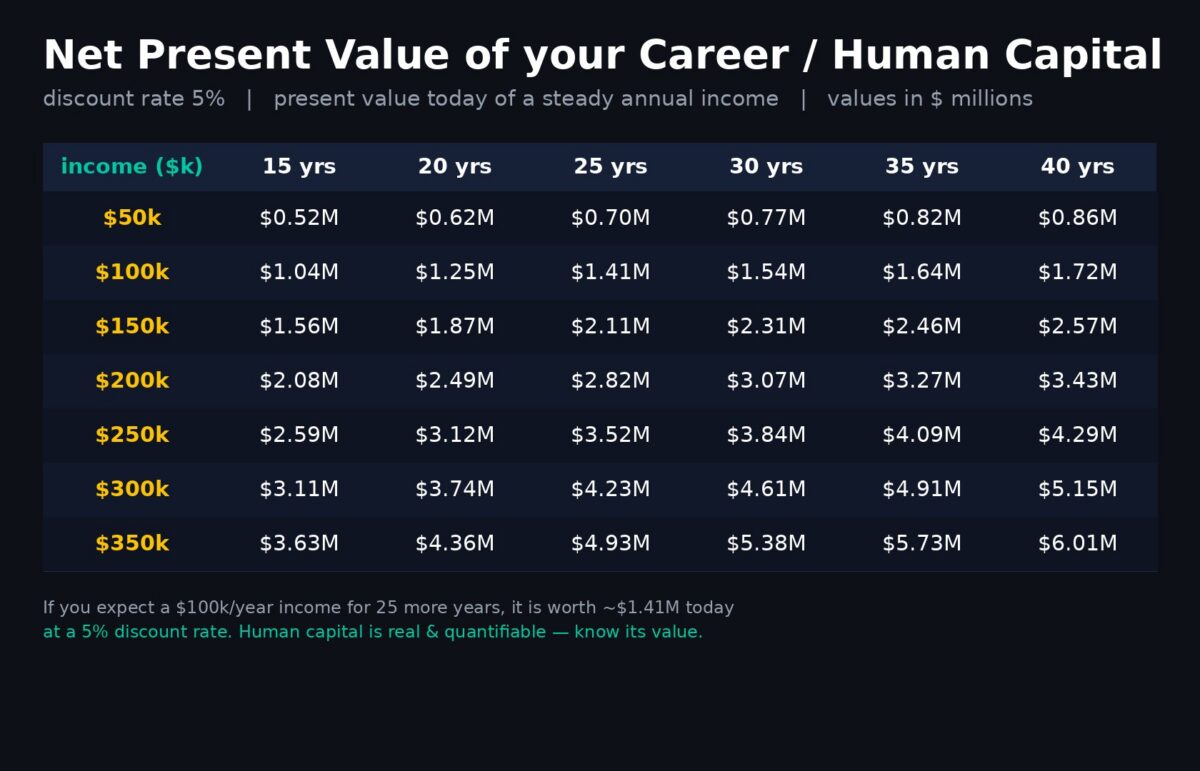
Here’s the simple fact: if you earn for another 25 years, that’s not an abstract idea — it’s a number you can compute. And at a 5% discount rate, a steady $100k a year for 25 years is worth ~$1.41M today. That’s a real, quantifiable asset sitting at the top of your personal balance sheet, whether you acknowledge it or not.

How to compute it:
– Take your gross income
– Deduct taxes, non-recoverable contributions, and insurances
– Deduct employment-related costs — training, commute, anything work forces you to spend
– Discount the resulting net annual cash flow to present value over your expected working horizon

That’s your human capital. A number, not an abstraction.

Why it’s worth modeling:
1. It’s a mental tool for opportunity cost. Every career decision becomes a comparison of present values, not a hunch.
2. It surfaces tradeoffs. A better-paying role that costs more in tax, commute, and burnout isn’t automatically a raise.
3. It enables bigger decisions. Career moves, new roles, earlier retirement, sabbaticals — all become clearer when you can weigh what you’re giving up against what you’re buying.

The reality check:
Next time someone casually floats a project that would cost a million dollars — frame it properly. That’s roughly the equivalent of an entire working lifetime for someone on a median US salary. A $1M commitment is a lifetime’s worth of labor, concentrated into one decision.

(A caveat for precision: the exact number depends on the discount rate — ~$0.94M at 5%, ~$1.27M at 3% — but the framing holds either way.)

Human capital is the asset you can’t diversify, can’t insure fully, and can’t buy back once spent. Know its value. Manage it like the balance-sheet anchor it actually is.

Categories
Articles

Why, as a finance professional, I use Python instead of Excel


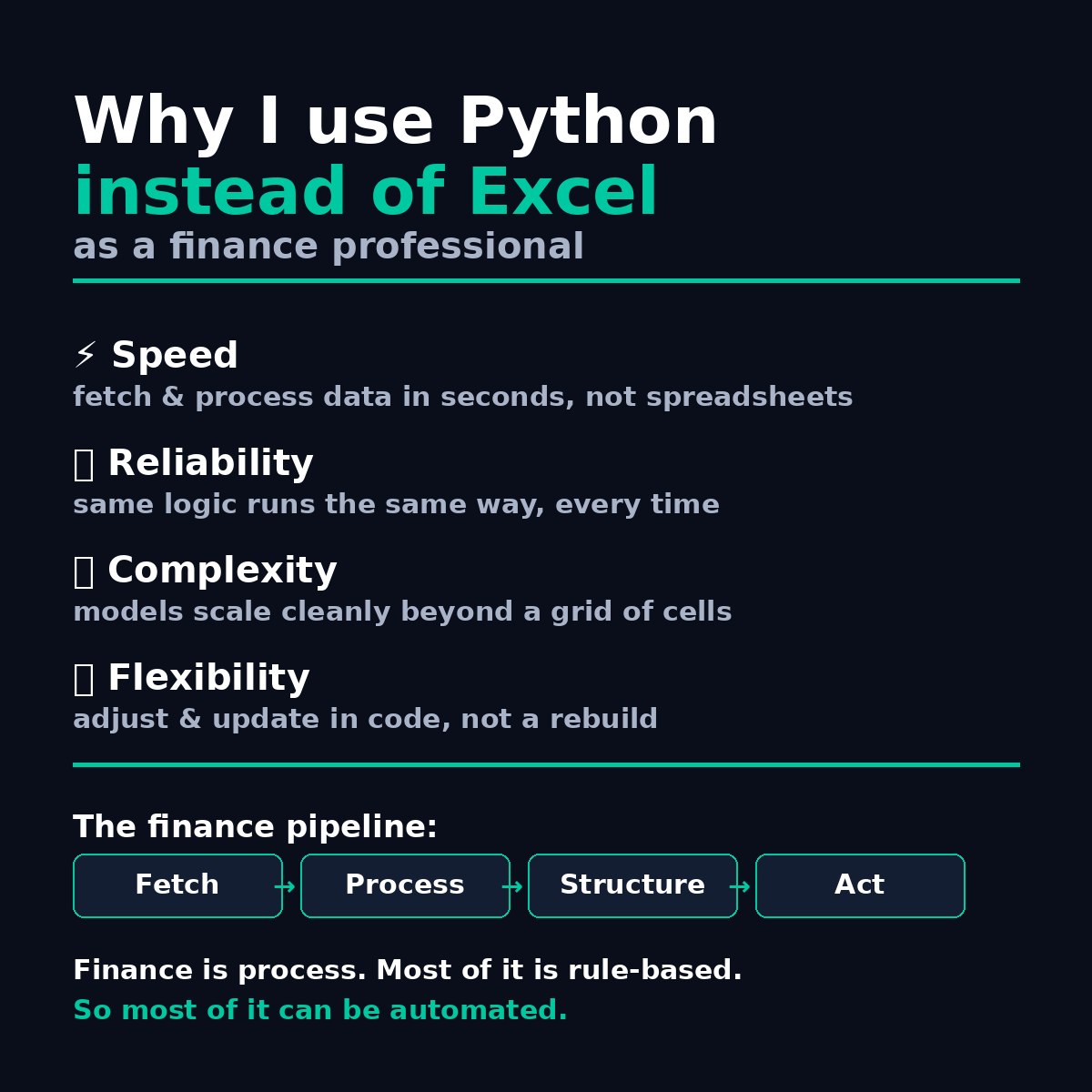
Finance is a lot of process. Specific data, specific steps, specific decision points. And most of that process is rule-based and logic-driven — which means it’s automatable.

Over the years, the share of my analytical work done in Excel has steadily shrunk — in favour of code editors. Today, less than 5% of my analytical work happens in Excel. The other 95%+ runs in Python and purpose-built analytical tools.

What Python gives me that Excel can’t:
– ⚡ Speed — fetch & process data in seconds, not spreadsheets
– ✅ Reliability — same logic runs the same way, every time
– 🧠 Complexity — models scale cleanly beyond a grid of cells
– 🔄 Flexibility — adjust & update in code, not a rebuild

The workflow: Fetch → Process → Structure → Act — each step automatable.

Excel is still great at what it’s great at. But for the process of finance, Python is the better tool. I’m a realist: I use both. The more complex and repeatable the work, the more I reach for code.

Categories
Articles

I hired a (personal) AI employee.

I hired a (personal) AI employee. It works for me in the background, and it’s now a permanent part of my “staff”.

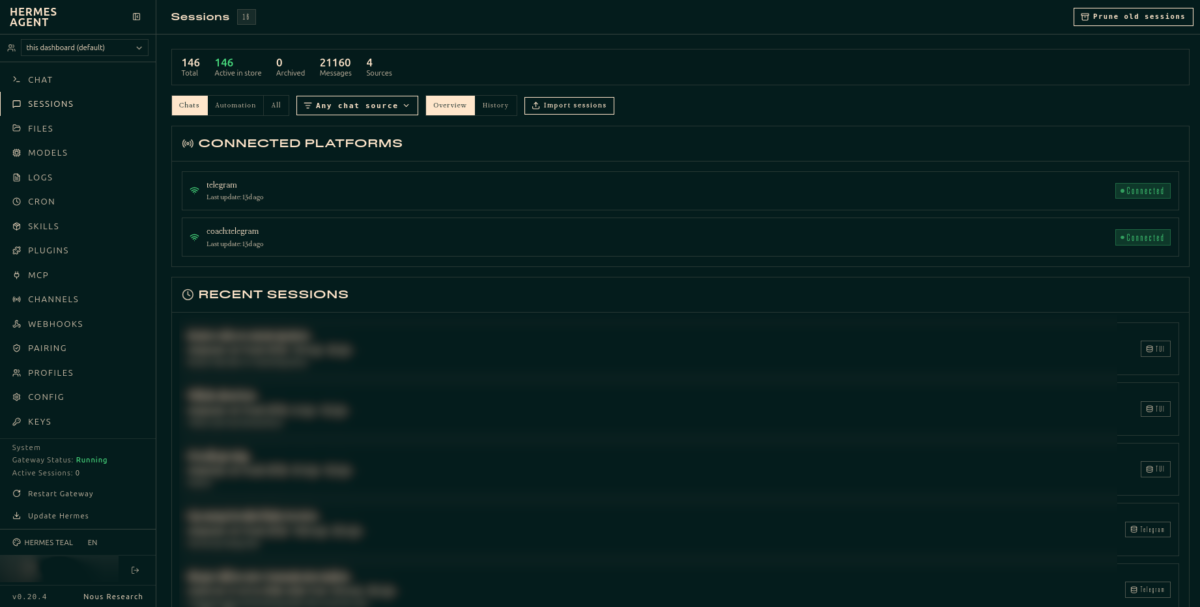
For over a month I’ve run Hermes Agent — an autonomous AI that lives on my hardware, has its own memory, and does things. Not a chatbot. A worker.

What it actually does for me:

🎬 1,500+ videos & articles → downloaded, transcribed, summarized, and filed into a searchable learning library. I just drop a link; it does the rest. And it structures the whole process — turning a chaotic stream of random finds into a clear curriculum and learning plan I can actually work through. A very different outcome from what the social media algorithm will feed you.

🔎 A research assistant that knows my standards. I throw topics at it and it scours various sources — with references, context, and analysis. It’s learned what matters to me in research, so the output comes back the way I’d want it, not generic.

📚 5 Anki (language learning) collections (66,901 media files) synced to my phone via a self-hosted server it deployed — and debugged when the SQLite schema broke.

🔐 My VPN — added a TCP fallback, managed the firewall, and diagnosed a carrier-NAT issue that was blocking me on mobile.

🧠 A private digital coach — its own persona, memory, and Telegram chat, checking in on my career and health. Runs on local models on my own hardware. My conversations never leave my infrastructure.

📝 A notes repository it maintains and cross-references automatically.

What I learned about managing it:

  1. Autonomy is the unlock. I brief it, it executes end-to-end, and reports back. I don’t babysit it.
  2. It fails — and self-corrects. Crashed containers, locked databases, retries. Resilience beats perfection.
  3. Memory compounds. It remembers my personal targets and goals, my health habits, my taste in music. Every interaction gets smarter.
  4. Privacy is a feature. My most personal conversations — with my coach — run on local models. No cloud, no training on my data.
  5. You still need judgment. It’s a tool, not a replacement for thinking. I review the important stuff.

The honest take: I’m a realist — I know what technology can and can’t do, and I don’t chase hype. But AI is maturing, and the potential is very significant. After weeks of real use, Hermes Agent has earned its place as permanent infrastructure, not a novelty. It’s the difference between having an assistant and having a staff.

Curious about hiring your own agent — and your own private coach — on your own hardware? Happy to share what I’ve learned.

Categories
Videos

Exponential growth and epidemics

A brilliant video explaining the math involved in the exponential growth of epidemics and how measures to reduce exposure can reduce the spread by orders of magnitude. Video credit: 3Blue1Brown

Categories
Videos

What is the Fourier Transform? A visual introduction.

Credit for the video: 3Blue1Brown

Categories
Videos

Introduction to Monte Carlo methods

Credit for the video: Alon Honig

Categories
Videos

Space: The Next Trillion Dollar Industry

Categories
Videos

Ever wonder how block-chain actually work?

Concise video summary explaining the core ideas of block chain and the mechanics of cryptocurrencies.

Specifically on how need for trust in executing transactions is eliminated in this protocol.

Categories
Videos

Why Cities are where they are

Categories
Videos

Indestructible Coating?!

Indestructible Coating?! – ft Veritasium