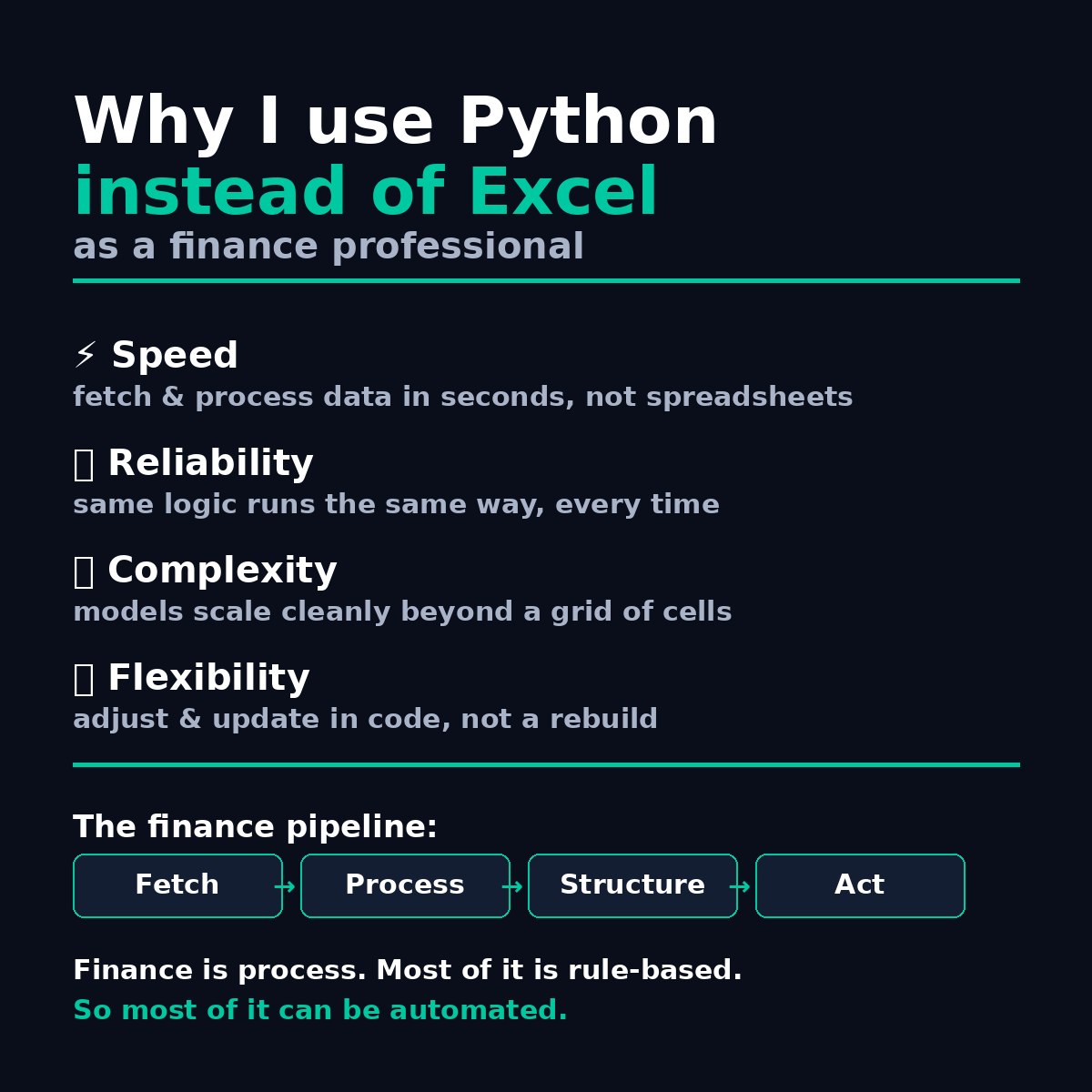
Finance is a lot of process. Specific data, specific steps, specific decision points. And most of that process is rule-based and logic-driven — which means it’s automatable.
Over the years, the share of my analytical work done in Excel has steadily shrunk — in favour of code editors. Today, less than 5% of my analytical work happens in Excel. The other 95%+ runs in Python and purpose-built analytical tools.
What Python gives me that Excel can’t:
– ⚡ Speed — fetch & process data in seconds, not spreadsheets
– ✅ Reliability — same logic runs the same way, every time
– 🧠 Complexity — models scale cleanly beyond a grid of cells
– 🔄 Flexibility — adjust & update in code, not a rebuild
The workflow: Fetch → Process → Structure → Act — each step automatable.
Excel is still great at what it’s great at. But for the process of finance, Python is the better tool. I’m a realist: I use both. The more complex and repeatable the work, the more I reach for code.